Noctourism: Why Everyone Is Looking Up
“Noctourism” means travelling for the night sky: aurora chasing, stargazing and dark-sky parks. It is one of the fastest-growing travel ideas of 2026 and 2027, helped by a solar cycle (Solar Cycle 25) that has been producing strong aurora activity. The peak is passing, and activity usually stays elevated for a couple of years afterward, so the next two winters are still good chances.
The mistake we see most often is booking a three-night package in a cloudy coastal town. The aurora needs two things: a geomagnetic storm and a clear sky. You cannot control the first. You can improve the second by choosing a place with a good microclimate, staying long enough for the weather to change and learning to find your own viewpoint by bus or on foot, rather than paying $250 (≈ €220 / £195) a night for a guided coach.
The six places below are ranked by aurora odds, daily cost at three levels, and how easily you can see the sky without a tour. Costs are typical daily figures for one person, checked in October 2026, and the tiers are estimates. Nobody can guarantee the lights, so we say plainly how likely each place is. If you are weighing two destinations, our comparison tool will line them up, or read our guide to destination dupes.
1. Abisko National Park, Sweden
Why it wins: Abisko wins on weather, not latitude. The Lapporten valley sits in the rain shadow of the surrounding mountains, so skies here are clear more often than on the Norwegian coast an hour or two away. This is the “Blue Hole” effect that aurora watchers talk about. You can reach it without a car: the overnight train from Stockholm takes about 17 hours and stops at the national park station.
Aurora odds and microclimate
- Among the best clear-sky odds in Scandinavia, roughly one night in two in the main season. Bring a headtorch; the village has almost no light pollution.
Best months
- Late September–October and February–March. December is the darkest month but often snowy.
The three-tier numbers
- Backpacker: $65 (≈ €60 / £50)/day
- Mid-range: $150 (≈ €135 / £120)/day
- Luxury: $310 (≈ €280 / £240)/day
How to see the lights without a $250 (≈ €220 / £195) tour
- Take the chairlift to the Aurora Sky Station if you want a guided view, or skip it and walk from the train station to the lake shore after dark. Most nights you can see the sky from outside your accommodation.
Safety and winter driving
- Winter is -15°C / 5°F to -25°C / -13°F. Dress in layers, carry spare batteries and keep to marked paths in the dark. The train is reliable but can be delayed by snow, so leave a spare day.
2. Tromsø, Norway
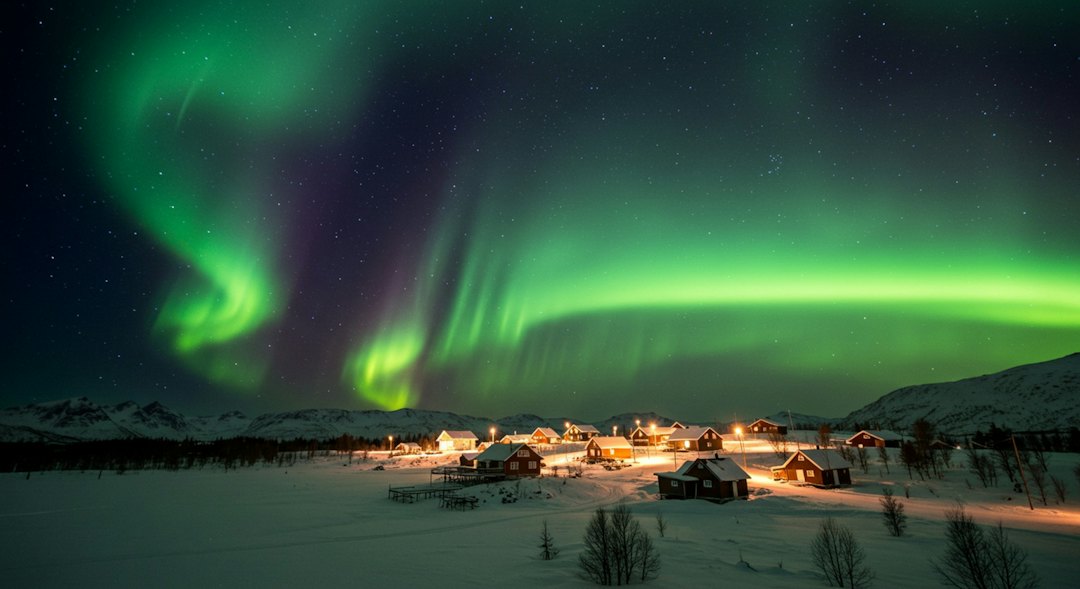
Why it wins: Tromsø is the easiest aurora base if you do not want to drive. It sits at 69°N, directly under the auroral oval, and the Gulf Stream keeps winter near -4°C (25°F), far milder than inland Lapland. City buses reach dark spots such as Telegrafbukta beach, and the town has good fish soups, reindeer and a coffee scene.
Aurora odds and microclimate
- Good, but coastal weather changes by the hour. On cloudy nights, guided buses chase gaps in the cloud, which is useful if you have only a few evenings.
Best months
- September–October and February–March; the Polar Night from late November to mid-January is dark but the sun never rises.
The three-tier numbers
- Backpacker: $80 (≈ €70 / £65)/day
- Mid-range: $195 (≈ €175 / £155)/day
- Luxury: $410 (≈ €370 / £320)/day
How to see the lights without a $250 (≈ €220 / £195) tour
- Take the bus to Telegrafbukta or walk out of the centre toward Prestvannet lake. Check the cloud forecast on Yr.no before choosing a direction.
Safety and winter driving
- Ice is the main hazard: wear grippy soles. If you do rent a car, drive slowly on unlit, icy roads and watch for reindeer.
3. Rovaniemi and Inari, Finnish Lapland
Why it wins: Rovaniemi gives you the winter-holiday side: husky and reindeer rides and the Arctic Circle. Inari, roughly four hours north, gives you the dark. Lake Inari has very little light pollution and, as the farthest north of the Finnish stops, some of the best views. Combine them if you have a week.
Aurora odds and microclimate
- Fair to good, inland and colder than the coast, with clear nights often following a cold snap. Rovaniemi has more light pollution than Inari.
Best months
- September–October and February–March. Christmas week is the busiest and most expensive.
The three-tier numbers
- Backpacker: $75 (≈ €65 / £60)/day
- Mid-range: $190 (≈ €170 / £150)/day
- Luxury: $480 (≈ €430 / £380)/day
How to see the lights without a $250 (≈ €220 / £195) tour
- Walk out of Rovaniemi toward the river and the Ounasvaara hill, or use a glass-roofed cabin in Inari. Long-distance buses run between the two towns.
Safety and winter driving
- Temperatures of -20°C / -4°F to -30°C / -22°F are normal in January. Rent a car with winter tyres only if you are comfortable on snow, and keep your phone warm: batteries die quickly.
4. Iceland: South Coast and North Iceland
Why it wins: Iceland has the cheapest flights from the UK and, often, from the US, and no other aurora country gives you glaciers, waterfalls and black beaches in the foreground. The catch is the weather. Akureyri and the north are often clearer than Reykjavik, and the south coast gives better scenery. See our Iceland guide for the rest of the island.
Aurora odds and microclimate
- Moderate: changeable Atlantic weather means you may see the lights on one night in three. Check the cloud map on vedur.is each afternoon.
Best months
- Late September–October and February–March. Deep winter has the most darkness but the most road closures.
The three-tier numbers
- Backpacker: $80 (≈ €70 / £65)/day
- Mid-range: $195 (≈ €175 / £155)/day
- Luxury: $400 (≈ €360 / £310)/day
How to see the lights without a $250 (≈ €220 / £195) tour
- Drive 20 minutes out of Reykjavik, away from the lights, or base yourself in Akureyri. Use the free forecast tools rather than a tour.
Safety and winter driving
- Winter driving in Iceland is the biggest risk. Check road.is and the vedur.is alerts before every drive, never enter a closed road, and consider a guided tour on storm days.
5. Cairngorms Dark Sky Park and the Isle of Skye, Scotland
Why it wins: Scotland offers the cheapest start for a dark-sky trip, with no Arctic flights and prices about half the Scandinavian ones. The Cairngorms hold an International Dark Sky Park, and the Isle of Skye has some of the darkest skies in Britain. The aurora here is rare and needs a strong solar storm, but the Milky Way on a clear night is reliable. See our Scotland guide for the route.
Aurora odds and microclimate
- Low for the aurora, often a handful of nights a year, but stargazing is excellent when the cloud breaks. Look north and use a forecast alert.
Best months
- October–March, with the longest nights from November to February.
The three-tier numbers
- Backpacker: $50 (≈ €45 / £40)/day
- Mid-range: $125 (≈ €110 / £100)/day
- Luxury: $260 (≈ €230 / £200)/day
How to see the lights without a $250 (≈ €220 / £195) tour
- Walk out of Tomintoul or Glenlivet in the Cairngorms, or visit the Quiraing on Skye on a clear night. Cairngorms stargazing needs only a flask and a torch.
Safety and winter driving
- Scottish winter weather can close single-track roads, and the nights are cold and damp. Keep to the signed paths and tell someone your route.
6. Yellowknife or Jasper Dark Sky Preserve, Canada
Why it wins: Yellowknife is flat, dry and continental, so the sky is clear far more often than on the coast. Tour operators cite up to about 240 nights a year with aurora activity overhead; treat that as a best case. Jasper trades latitude for scale: its Dark Sky Preserve is one of the largest in the world that you can reach by road.
Aurora odds and microclimate
- Excellent in Yellowknife, often better than one night in two, and variable in Jasper, where mountains can block the view north.
Best months
- Yellowknife: late August–April. Jasper: October–March, with the Dark Sky Festival in the autumn.
The three-tier numbers
- Backpacker: $65 (≈ €60 / £50)/day
- Mid-range: $160 (≈ €145 / £125)/day
- Luxury: $340 (≈ €300 / £270)/day
How to see the lights without a $250 (≈ €220 / £195) tour
- In Yellowknife, take a taxi to a lake shore outside the city, or in Jasper walk to Pyramid Lake or Maligne Lake after dark. Both are easier with a car.
Safety and winter driving
- Yellowknife can drop to -30°C / -22°F or colder, so hand warmers, insulated boots and a car with a block heater matter. Check road conditions on the Alberta and Northwest Territories sites before travelling.
Which Destination Fits You?
The best base depends on how you travel, not just on the odds. Use these as a starting point, then check the forecast for your dates.
If you have only three or four nights, choose a place with good odds and a short transfer. If you have a week, you can afford a cloudier region.
By travel style
- No car, first-timer: Tromsø, with buses to dark beaches and plenty to do on a cloudy day.
- Best odds on a train budget: Abisko, which is cheap to reach from Stockholm and often clear.
- Families and winter-holiday feel: Rovaniemi, then a night or two in Inari for darker skies.
- Scenery first, aurora second: Iceland, with waterfalls and glaciers as the foreground.
- Lowest cost: Scotland, as long as you treat the aurora as a bonus and the stars as the point.
- Highest odds overall: Yellowknife, if you can afford the flight and the cold.
Comparison Matrix: Six Dark-Sky Destinations
Clear-sky odds are rough estimates for the main season, not forecasts. The equinox months (late September–October) are milder and cheaper. Deep winter (January–March) is colder, with more darkness.
| Destination | Latitude | Clear-sky odds (approx.) | Mid-range / day | Car needed? | Best months |
|---|---|---|---|---|---|
| Abisko, Sweden | 68°N | About 50% | $150 (≈ €135 / £120) | No | Late Sep–Oct, Feb–Mar |
| Tromsø, Norway | 69.6°N | About 30–35% | $195 (≈ €175 / £155) | No | Late Sep–Oct, Feb–Mar |
| Rovaniemi & Inari, Finland | 66.5°N / 69°N | About 40–45% | $190 (≈ €170 / £150) | Inari: yes | Late Sep–Oct, Feb–Mar |
| Iceland | 64–66°N | About 30–35% | $195 (≈ €175 / £155) | Yes | Late Sep–Oct, Feb–Mar |
| Cairngorms & Skye, Scotland | 57°N | Low (aurora rare) | $125 (≈ €110 / £100) | Yes | Oct–Mar |
| Yellowknife / Jasper, Canada | 62°N / 53°N | About 50–60% (Yellowknife) | $160 (≈ €145 / £125) | Jasper: yes | Late Aug–Mar |
The DIY Aurora Chaser's Toolkit
Most of what a tour sells, you can do yourself with a phone, a bus timetable and the right clothes. Three things matter: the forecast, the camera and the cold.
Free forecasts and apps
- My Aurora Forecast: shows the Kp index and an alert for when the lights are likely.
- Yr.no: the Norwegian weather service, with hourly cloud cover for Scandinavia.
- Vedur.is: Iceland's weather office, with a cloud-cover map that is worth checking each afternoon.
- Cloud cover matters more than the Kp number: a quiet aurora under clear sky beats a strong storm under cloud.
Phone camera settings
- Switch on Night Mode and hold the phone still for 5 to 10 seconds.
- Use a small tripod or rest the phone on a rock or bag.
- Turn off the flash, lock focus on infinity if you can, and keep a spare battery in a warm pocket.
Thermal layering
- Wear a thin wool base layer, an insulating middle layer and a windproof outer shell.
- Choose insulated, waterproof boots a size up, with wool socks.
- Pack a warm hat, liner gloves under mittens and hand warmers; cold fingers end most nights early.
Northern Lights Budget Questions
What is the cheapest country to see the Northern Lights?
Scotland is the cheapest on daily costs, at about $125 (≈ €110 / £100) mid-range, but the aurora is rare there. For reliable lights on a budget, Abisko in Sweden (about $150 (≈ €135 / £120) mid-range) and Iceland or Tromsø (about $195 (≈ €175 / £155)) are the better value, and Abisko is reachable by train.
Is October/November or February/March better for the Aurora Borealis?
Neither is guaranteed. Late September to October is milder and cheaper, with more equinox storms, while February and March are colder but often clearer. November is the cloudiest month in many coastal areas, so choose the equinox months or late winter.
Do you need to book an expensive guided Northern Lights tour?
No. A tour can help on cloudy nights, but you can see the lights without one by choosing a dark spot, checking the forecast and using public buses in Tromsø or a short walk in Abisko. Save the tour for a stormy night when you do not want to drive.
How many nights should you stay to guarantee seeing the Northern Lights?
Nothing guarantees it. Plan four to five nights in a good clear-sky region to give yourself several chances, and keep your evenings free. A week in Abisko or Yellowknife gives you good odds.